
- OUR MACHINES
- Manual Shrink Wrapping Machines
- Semi-Automatic Shrink Wrapping Machines
- Fully Automatic Shrink Wrapping Machines
- Fully Automatic Side Seal Machines
- High Speed Fully Automatic Machines
- Shrink Tunnels
- Bundle (Sleeve Wrapper)
- Mailing Systems
- Carton Sealers / Carton Erectors
- Pallet Wrapping
- Vacuum Machines
- Roller Die Cutters
- Skin Machines
- Flow Wrap Machines
- Form Fill Seal Machines
- High Frequency Sealers
- Verticle Form Fill Sealing Machines
- Filling Machines
- Capping Machines
- Doy Pack Machines
- Over wrapping Machines
- Metal Detector and Check Weigher
- Labelling Machines
- Bagging Systems
- Top Seal Machines
- Seal Stretch Machines
- Blister Machines
- Horizontal Wrapping Systems
- Robotic Systems
- In Feed / Out Feed Conveyors
- PACKAGING FILMS
- Polyethylene
- Polyolefin
- BOPP Film
- Polypropylene
- PVC Films
- Stretch Films
- SECOND HAND MACHINES
- Second Hand Machines
How to Choose the Right Shrink Wrapping Machine for Your Production Line
Most packaging bottlenecks do not start at the pallet. They start earlier, where finished goods leave packing and wait for a seal, a tunnel pass, or a spare operator who can free up a hand. If your team is still bagging by hand, chasing inconsistent seals, or running overtime just to clear the day’s orders, the problem is rarely “more people”. It is usually the wrong shrink wrapping machine for the volume, product mix, and labour reality on your floor.
Australian manufacturers, food producers, contract packers and warehouse operations face the same decision every year: stick with a chamber or L-bar setup that once worked, or step up to a system that keeps pace with demand. The right choice cuts film waste, protects presentation, and frees skilled staff for higher value work. The wrong one locks you into slow changeovers, damaged product and a machine that sits idle half the week.
This guide walks through how to choose a shrink wrapping machine for a real production line, not a brochure. It covers throughput, product size, seal style, film, automation level and the practical checks Minipack International runs with customers before recommending equipment.
What a Shrink Wrapping Machine Actually Does on the Production Line
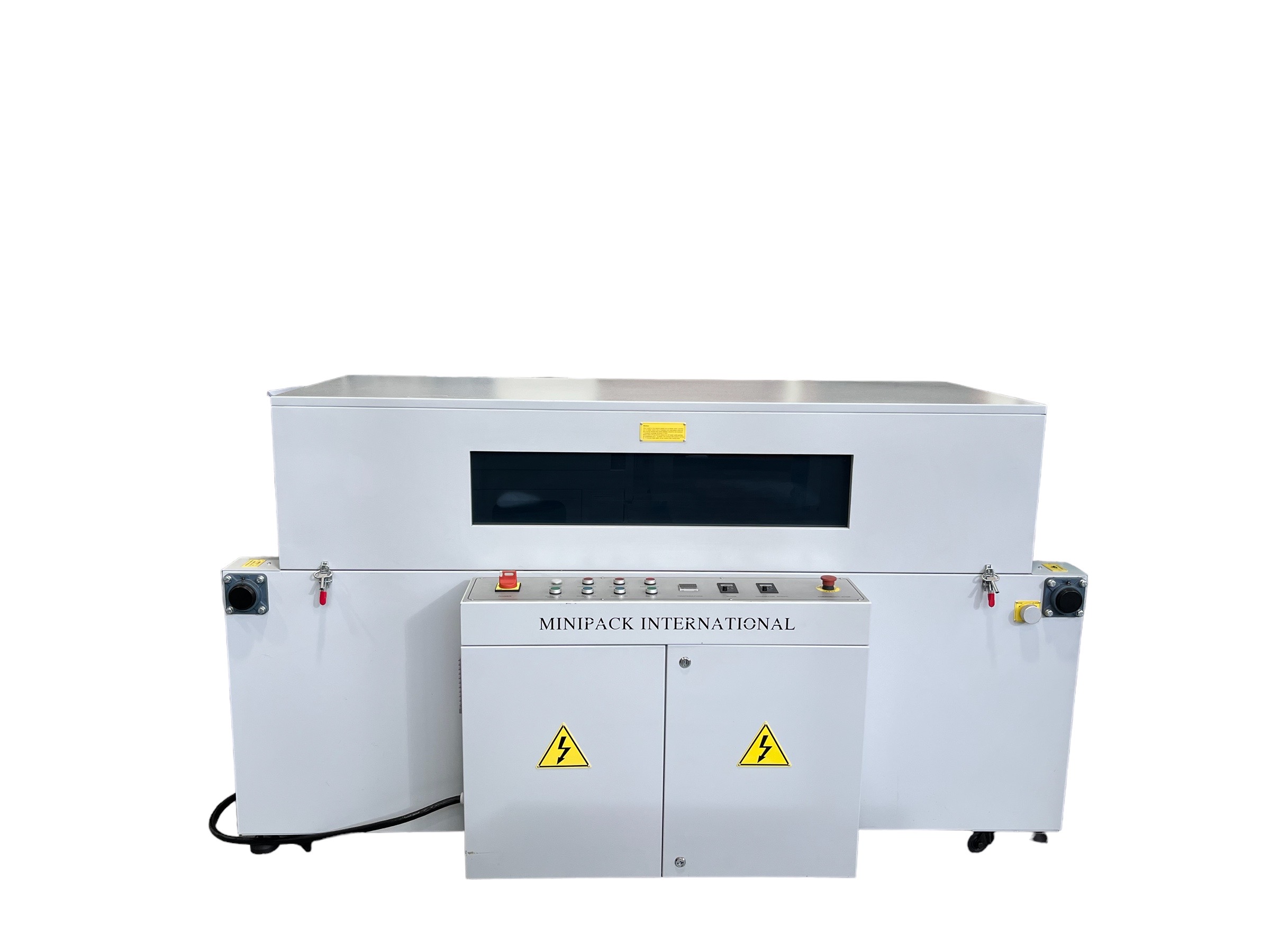
A shrink wrapping machine encloses a product (or multipack) in film, seals the film, then applies controlled heat so the film tightens to the pack. Done well, you get a clean, tamper-evident finish that protects against dust, moisture and handling damage. Done poorly, you get dog-ears, burn holes, loose packs that scuff in transit, and operators who stop trusting the machine.
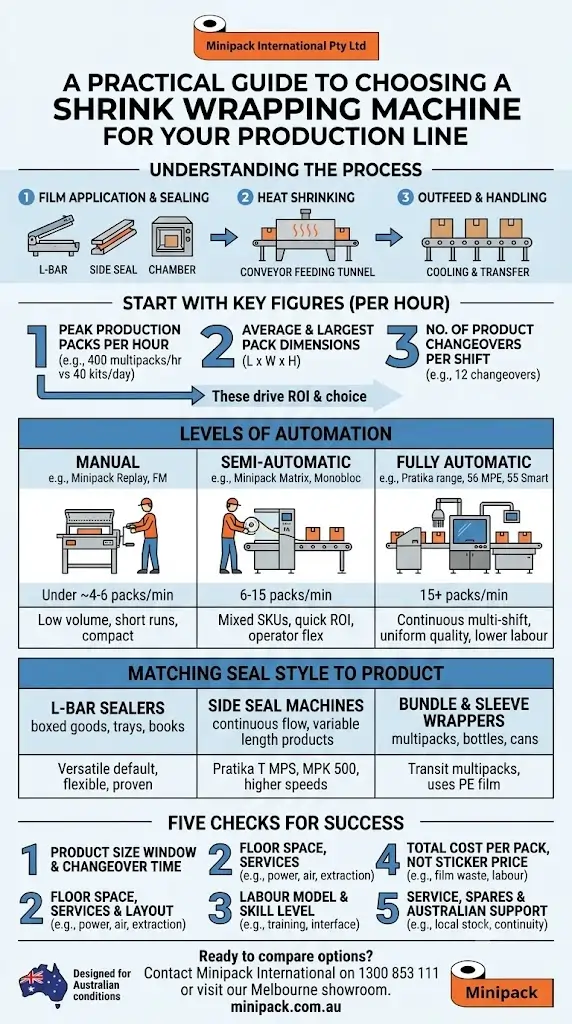
On most Australian lines the process breaks into three stages:
- Film application and sealing — chamber seal, L-bar seal, side seal or sleeve wrap, depending on the machine type.
- Heat shrinking — either inside an integrated chamber or through a separate shrink tunnel.
- Outfeed and handling — conveyor discharge, cooling, labelling or transfer into carton sealing and pallet wrapping.
Understanding those stages matters because buying “a shrink wrapper” without matching seal method, tunnel capacity and infeed style to your product is how plants end up with expensive underused kit.
Start With Throughput, Not the Machine Catalogue
Before you compare models, write down three numbers for a normal week and a peak week:
- Packs per hour you need to clear during peak production.
- Average pack dimensions (length, width, height) and the largest pack you must run.
- How many product changeovers you do per shift.
Those three figures drive almost every sensible recommendation. A bakery packing 400 multipacks an hour has a completely different requirement from a hardware supplier wrapping 40 large kits a day. If you only know “we are busy”, you will overbuy automation you cannot feed, or underbuy and keep the bottleneck exactly where it is.
As a rough guide used on many producint line floors:
- Under ~4–6 packs per minute — a quality manual or compact chamber system can still make commercial sense if labour is available and product size is consistent.
- Around 6–15 packs per minute — semi-automatic L-sealers with conveyor discharge usually pay back quickly.
- 15+ packs per minute, or continuous multi-shift work — fully automatic L-bar or side seal systems become the practical path, especially where labour is hard to hold.
Treat those bands as starting points, not hard rules. Irregular shapes, multipacks, printed film registration and food hygiene requirements all shift the recommendation.
Manual, Semi-Automatic or Fully Automatic?
Minipack International supplies the full spectrum, from entry chamber units through high speed automatic lines. Matching automation level to your operation is the single biggest cost and ROI decision.
Manual shrink wrapping machines
Manual shrink wrapping machines suit lower volumes, frequent product trials, short runs and sites where one operator can manage packing without becoming a permanent bottleneck. Chamber-style units such as the Minipack Replay and FM ranges seal and shrink in one compact footprint, which helps smaller factories and dark stores short on floor space.
They are also a smart first step when you are replacing hand bagging and heat guns. Consistency improves immediately, presentation lifts, and you build internal knowledge before investing in a full automatic line.
Watch the labour equation carefully. If one person is permanently tied to the machine and peak orders still spill into overtime, “cheap to buy” is not cheap to run.
Semi-automatic shrink wrapping machines
Semi-automatic shrink wrapping machines are the workhorse for many Australian manufacturers. The operator places the product in the film, the L-bar seals, and a conveyor typically feeds a shrink tunnel. Models such as the Minipack Matrix series and Monobloc systems raise output without the capital and integration cost of a fully automatic infeed.
They suit mixed SKU environments where an operator still needs to orient product or build multipacks by hand. You gain seal consistency and tunnel quality while keeping flexibility. For many mid-size food, cosmetics, print and industrial goods operations, this is the sweet spot for the next three to five years of growth.
Fully automatic shrink wrapping machines
When volume is high and product presentation is part of the brand, fully automatic shrink wrapping machines remove the seal cycle from the operator’s hands. Systems in the Pratika range, including the Pratika 56 MPE and Pratika 55 Smart, are built for continuous production with automatic product infeed, sealing and transfer into the tunnel.
Automatic systems shine when:
- You run long batches of similar products.
- Labour cost or labour availability is a standing problem.
- Retail or export customers demand uniform pack quality.
- You are planning end-of-line automation that includes carton sealing and pallet wrapping downstream.
They need a stable infeed. If product arrives skewed, stacked or at irregular gaps, fix that first or the automatic wrapper will only advertise the upstream mess.
L-Bar, Side Seal or Sleeve Bundle: Matching Seal Style to Product
Not every product belongs on the same seal geometry. Choosing the wrong style is a common reason plants fight film waste and ugly packs.
L-bar sealers
L-bar machines create a seal along two sides of the pack in an “L” shape. They are versatile for boxed goods, trays, books, cosmetics, hardware kits and many food multipacks. Chamber machines combine seal and shrink; separate L-sealers pair with a tunnel for higher output. For a huge share of Australian SKUs, an L-bar setup is still the default for good reason: flexible, proven and easy for staff to learn.
Side seal machines
Side seal machines continuously seal along the length of the product and are better when pack length varies or you need higher continuous speeds. Models such as the Pratika 56 T MPS and Box Motion MPK 500 handle longer products more cleanly than a fixed L-bar frame. If you wrap items that change length often, or you are chasing higher packs per minute with centre-folded film, side seal deserves a serious look.
Bundle and sleeve wrappers
When the job is multipacking bottles, cans, cartons or trays into a retail or transit bundle, a bundle wrapping machine (sleeve wrapper) is usually the better tool. Sleeve systems wrap a band of film around a collated group, then shrink it into a tight multipack. That is a different commercial problem from single-item presentation wrap, and forcing multipacks through a standard L-bar often wastes film and time.
If your line is really a bundling line, say so early in the enquiry. It changes the machine family completely.
Do Not Treat the Shrink Tunnel as an Afterthought
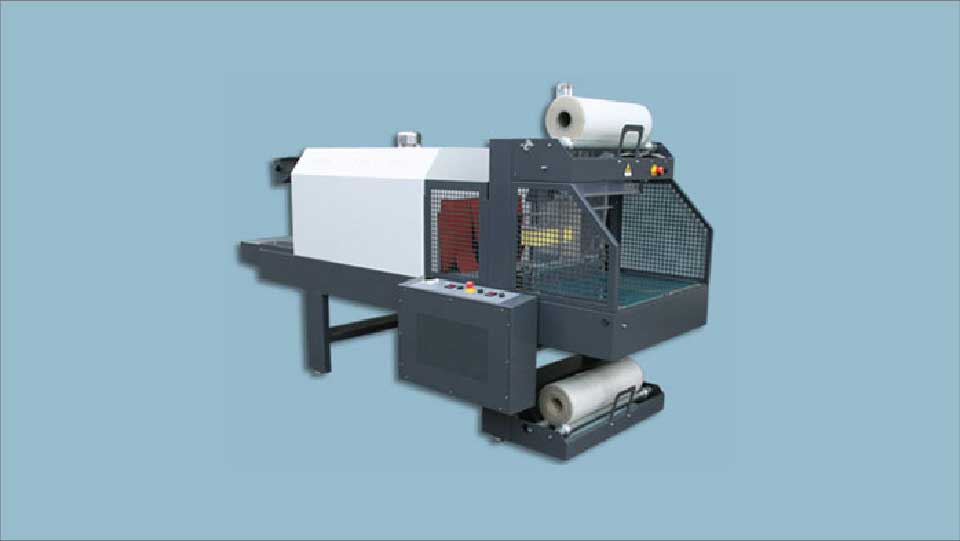
The sealer gets the attention. The tunnel decides whether the pack looks retail-ready. Undersized tunnels, uneven airflow or the wrong temperature profile show up as wrinkled film, burnt corners and soft packs that crush in the carton.
When you specify a system, match tunnel opening, belt speed and heat capacity to your largest pack and your target rate. Minipack’s heat shrink tunnel range includes options such as the 50 Digit Twin and 70 Digit for different pack heights and duty cycles. Stainless (Inox) tunnels matter in food and wet environments where washdown and corrosion resistance are non-negotiable.
Practical tip: run sample product through a tunnel at the speeds you actually need, not the brochure maximum. Film type, pack mass and conveyor loading all change the result.
Film Choice Affects Machine Choice
Existing Minipack content already covers film chemistry in depth, so this section stays operational. The short version for machine selection:
- Polyolefin shrink film is the modern default for many retail packs: strong, clear, food-contact friendly grades available, and it performs well on a wide range of sealers and tunnels. See Minipack’s polyolefin range when presentation matters.
- PVC shrink film still appears in some applications but brings different handling, odour and workplace considerations. Match machine settings and extraction to the film you will actually buy.
- PE film is common on bundle and sleeve systems for transit multipacks where toughness beats crystal clarity.
Buy machine and film as a system. A sealer tuned for one film family will frustrate you if procurement later switches gauge or chemistry to save a few cents per metre. Minipack supplies both machinery and film, which simplifies that match and keeps one team accountable for pack quality.
Five Checks That Separate a Good Buy From an Expensive Mistake
Use this checklist before you sign a purchase order.
1. Product size window and changeover time
List your smallest and largest SKUs. Confirm the sealing frame, tunnel aperture and infeed guides cover both without heroic workarounds. Ask how long a trained operator needs to change from SKU A to SKU B. If you run 12 changeovers a day, a two-minute difference per changeover is real money.
2. Floor space, services and line layout
Measure the true footprint including infeed, outfeed, film roll changes and operator access. Check power, compressed air and extraction. A machine that only fits if you block a fire exit is not a solution. Plan how packs leave the tunnel and whether they go straight to a carton sealer or packing table.
3. Labour model and skill level
Be honest about who will run the machine on night shift. Touchscreen recipes, automatic film waste winders and simple fault messages matter more on a multi-shift plant than on a single skilled day crew. Training and local support should be part of the quote, not an afterthought.
4. Total cost per pack, not sticker price
Add film usage, scrap rate, labour minutes per pack, planned maintenance and expected downtime. A lower-priced sealer that wastes 15% more film or needs constant babysitting loses to a dearer automatic unit inside a year on many lines. Ask for a trial wrap of your actual product so you can measure film consumption properly.
5. Service, spares and Australian support
Packaging machines earn their keep when they run. Confirm spare parts stock in Australia, response times, and whether the supplier can service what they sell. Minipack International has operated from Melbourne for decades with showroom demonstration, installation support and ongoing service — that continuity matters when a seal bar or tunnel element fails during a peak season.
Where Shrink Wrapping Sits in End-of-Line Automation
Shrink wrapping rarely lives alone. On a growing line it sits between primary packing and the carton/pallet stage. A coherent layout might look like:
- Product collated or single-filed into the shrink wrapping machine.
- Sealed and tunnel-shrunk packs discharged and cooled.
- Optional labelling or coding.
- Carton erecting and sealing.
- Pallet stacking and stretch wrapping for despatch.
If you already know pallet wrapping is the next investment, design the shrink outfeed with that path in mind. Minipack also supplies pallet wrapping equipment and robotic palletising, so the conversation can cover the full end of line rather than a single orphaned machine in the middle of the floor.
The commercial takeaway is simple: buy the shrink wrapping machine that clears today’s peak without drama, and that can hand off cleanly to the next automation step you are likely to take within two to three years. Stretching a manual chamber past its sensible limit usually costs more than stepping up one level at the right time.
A Practical Decision Path You Can Use This Week
If you need a clear next step, run this sequence with your operations and procurement leads:
- Time how long it currently takes to wrap 50 representative packs, including film changes and rework.
- Calculate labour cost and overtime tied to packing for the last quarter.
- Photograph your five highest volume SKUs and your most awkward SKU.
- Estimate packs per hour at peak for the next 18 months, not just last month.
- Decide whether the job is single-item presentation wrap, multipack bundling, or both.
- Book a demonstration with sample product so you can see seal quality, film use and changeover on real machines.
Bring those notes to a supplier meeting and you will get a sharper recommendation. Vague enquiries produce vague quotes. Specific throughput, dimensions and pain points produce a machine shortlist you can defend to finance.
Why Australian Buyers Work With Minipack International
Minipack International specialises in packaging machinery and film for Australian conditions. The range covers manual chamber systems, semi-automatic L-sealers, fully automatic L-bar and side seal machines, shrink tunnels, sleeve and bundle wrappers, plus the carton and pallet equipment that sits around them. That breadth matters because the right answer is not always “the biggest automatic on the page”. Sometimes the profitable move is a robust semi-automatic line with the correct tunnel and film. Sometimes it is a side seal automatic that finally stops fighting long products.
You can view machines, discuss layout, and test pack formats with a team that understands local power, labour and retail expectations. From the Campbellfield showroom in Melbourne, support extends to manufacturers and distribution sites nationally.
If your packing area is the reason orders leave late, or your presentation quality is costing you retail listings, it is time to stop patching the process with extra hands. Choose the shrink wrapping machine that matches your real throughput, product mix and growth plan — then build the rest of the end of line around it.
Ready to compare options against your products? Contact Minipack International on 1300 853 111 or visit the Campbellfield showroom to run a practical demonstration.
Choosing a shrink wrapping machine is an operations decision dressed up as an equipment purchase. Throughput, pack geometry, seal style, tunnel performance, film and labour availability all weigh more than a glossy feature list. Manual systems still earn their place on low volume and flexible lines. Semi-automatic L-sealers remain the backbone of many Australian plants. Fully automatic L-bar and side seal machines unlock multi-shift consistency when volume and labour pressure justify them. Bundle and sleeve systems solve multipack problems that standard sealers should not be forced to handle.
Map your peak rate, measure your SKUs, cost your current labour and film waste, then trial real product. That process leads to a machine that protects margin instead of decorating the factory floor. Minipack International can help you work through that selection with equipment, film and local support under one roof.
Frequently Asked Questions
What is the best shrink wrapping machine for a small Australian manufacturer? For many small plants, a quality manual chamber machine or a compact semi-automatic L-sealer is the best starting point. Choose based on packs per hour at peak, not average day volume. If one operator can clear peak demand without regular overtime, manual or light semi-auto is often enough. If packing already spills into overtime every busy week, step up sooner.
How do I know when to move from semi-automatic to fully automatic shrink wrapping? Move when peak demand regularly exceeds what one trained operator can seal consistently, when labour is hard to recruit or retain, or when retail customers reject variable pack quality. If you are already feeding a tunnel as fast as an operator can load an L-bar, automatic infeed is usually the next lever.
Do I need a separate shrink tunnel? Chamber machines seal and shrink in one unit and suit lower volumes. Higher output L-bar and side seal lines almost always pair with a dedicated heat shrink tunnel so sealing and shrinking can run as a continuous process. Match tunnel size and heat capacity to your largest pack and target speed.
What is the difference between an L-bar sealer and a side seal machine? An L-bar seals two sides of the pack in an L-shaped cycle and suits a wide range of boxed and trayed products. A side seal machine seals continuously along the pack length and is better for variable length products and higher continuous speeds. Long or frequently changing pack lengths often favour side seal.
When should I use a bundle or sleeve wrapper instead? Use a bundle or sleeve wrapper when you are multipacking bottles, cans, cartons or trays into a transit or retail group. Sleeve systems apply a band of film around a collated pack. Forcing multipacks through a single-item L-bar usually wastes film and slows the line.
Which shrink film should I run on a new machine? Polyolefin is the common choice for clear retail presentation and broad machine compatibility. PE is typical on many sleeve and bundle applications. PVC still appears in some niches but needs careful handling. Always trial the film you intend to buy on the machine you intend to run, at production speed.
How much floor space does a shrink wrapping line need? Allow space for the sealer, tunnel, infeed and outfeed conveyors, film roll changes and safe operator access. A semi-automatic L-sealer with tunnel is a different footprint from a single chamber unit. Measure the full process path, not only the machine base plate, before you commit.
Can one shrink wrapping machine handle many different product sizes? Yes, within the machine’s stated size window and if changeovers are practical. Confirm minimum and maximum pack dimensions, how guides adjust, and how long a changeover takes. High SKU counts favour machines with quick recipe recall and simple mechanical adjustment.
What ongoing costs should I budget for besides the machine price? Budget for shrink film, spare wear parts (seal elements, belts, teflon covers), scheduled service, power, and operator time. Film waste and rework often dwarf small differences in capital cost. Ask for expected film usage on your pack format during a demonstration.
Why buy from an Australian packaging machinery supplier? Local demonstration, installation, spares and service reduce downtime risk. A supplier that also understands carton sealing and pallet wrapping can design a coherent end of line instead of selling an isolated machine. Minipack International supports customers nationally (and internationally) from its Melbourne base with machinery and film.