
- OUR MACHINES
- Manual Shrink Wrapping Machines
- Semi-Automatic Shrink Wrapping Machines
- Fully Automatic Shrink Wrapping Machines
- Fully Automatic Side Seal Machines
- High Speed Fully Automatic Machines
- Shrink Tunnels
- Bundle (Sleeve Wrapper)
- Mailing Systems
- Carton Sealers / Carton Erectors
- Pallet Wrapping
- Vacuum Machines
- Roller Die Cutters
- Skin Machines
- Flow Wrap Machines
- Form Fill Seal Machines
- High Frequency Sealers
- Verticle Form Fill Sealing Machines
- Filling Machines
- Capping Machines
- Doy Pack Machines
- Over wrapping Machines
- Metal Detector and Check Weigher
- Labelling Machines
- Bagging Systems
- Top Seal Machines
- Seal Stretch Machines
- Blister Machines
- Horizontal Wrapping Systems
- Robotic Systems
- In Feed / Out Feed Conveyors
- PACKAGING FILMS
- Polyethylene
- Polyolefin
- BOPP Film
- Polypropylene
- PVC Films
- Stretch Films
- SECOND HAND MACHINES
- Second Hand Machines
Manual vs Automatic Pallet Wrapping Machines: How to Know When It’s Time to Upgrade
It’s 4.45pm on a Friday, and the truck is idling in the loading bay. Two staff are jogging around a pallet with a roll of stretch film, wrapping it by hand while the driver checks his watch. The tension is uneven, a few layers tear, and somebody grabs extra film “just to be safe.” Multiply that scene by every pallet, every day, across every shift, and you start to see why so many Australian warehouses and manufacturers are quietly bleeding money on something as ordinary as pallet wrap.
If that sounds familiar, you’re not alone. Pallet wrapping is one of those tasks that rarely gets questioned until freight arrives damaged, a workers’ compensation claim lands on someone’s desk, or the film budget blows out for the third quarter running. This article looks at when manual pallet wrapping stops making sense, what changes when you move to a pallet wrapping machine, and how to work out whether an automatic pallet wrapper will actually pay for itself.
The Real Cost of Manual Pallet Wrapping
On paper, manual wrapping looks cheap. There’s no capital outlay, no installation, no training beyond “here’s the film, go for it.” In practice, it’s rarely as simple as that, and the costs tend to hide in places that don’t show up on a single invoice.
Freight damage and rejected pallets
Hand wrapping produces inconsistent tension almost by definition. One operator wraps tight and fast, another wraps loose because their shoulder is sore from the last fifty pallets. Loads that aren’t uniformly contained shift in transit, corners crush, product settles unevenly, and freight carriers start rejecting pallets or logging damage claims. For food and beverage manufacturers, logistics companies, and anyone shipping product interstate on B-doubles, that inconsistency translates directly into chargebacks, re-work and unhappy customers.
Hidden labour costs
Wrapping pallets by hand is physically demanding. Walking around a pallet dozens of times a day, twisting to keep tension on the film, and repeating that motion for an entire shift is exactly the kind of repetitive task that leads to shoulder, wrist and lower back strain. It’s also slow. A pallet that takes an automatic wrapper ninety seconds might take a person four or five minutes, and that’s before accounting for fatigue toward the end of a shift when quality typically drops off. When you actually cost out the labour hours dedicated purely to wrapping pallets each week, most operations managers are surprised by the number.
Film waste that adds up quietly
Manual wrapping almost always uses more film than necessary because there’s no consistent pre-stretch. Machines can stretch film by 200 to 300 percent before it touches the load, meaning the same roll wraps significantly more pallets. Hand wrapping rarely achieves anything close to that, so businesses end up buying more stretch wrap film than they should, without ever really noticing the drift in the packaging machines budget.
What Changes When You Automate Pallet Wrapping
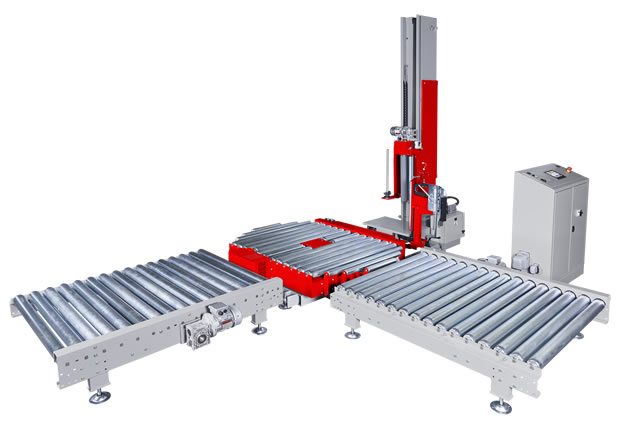
Automatic and semi-automatic pallet wrappers solve these problems by controlling the two variables that matter most: tension and consistency. A turntable or rotary arm machine applies film at a set pre-stretch ratio and a set number of wraps every single time, regardless of who’s operating the line or how tired they are by 3pm.
Semi-automatic vs fully automatic pallet wrappers
Not every business needs to jump straight to a fully automated line. A semi-automatic turntable wrapper, where an operator loads the pallet and starts the cycle but the machine handles the wrapping, is often the right first step for businesses moving thirty to eighty pallets a day. For higher volume operations, particularly distribution centres and manufacturers running multiple shifts, a fully automatic system integrated with conveyors removes the operator from the process almost entirely. Minipack’s range covers both ends of that spectrum, from compact rotating arm units like the MP30 rotating arm pallet wrapper through to complete automatic lines such as the MP4565 fully automatic pallet wrapping line, which handles high throughput without a person touching the film at all.
Consistent wrap force reduces film usage and damage together
This is the part that tends to surprise people: solving the labour problem and solving the film cost problem is usually the same exercise. A machine that pre-stretches film correctly and applies even tension uses less material per pallet and produces a tighter, more stable load. That means fewer freight claims and a lower cost per pallet at the same time, rather than having to trade one off against the other.
Signs Your Business Has Outgrown Manual Wrapping
There’s no single pallet count where automation suddenly becomes worthwhile, but a few warning signs tend to show up consistently in businesses that are ready to move on from hand wrapping:
- You’re wrapping more than 25 to 30 pallets a day and it’s tying up staff who could be doing higher value work
- Freight damage claims or carrier rejections have become a recurring line item rather than an occasional headache
- Stretch film spend has crept up year on year without a corresponding increase in volume
- Staff have raised WHS concerns about repetitive strain from manual wrapping
- You’re running multiple shifts and wrap quality visibly drops toward the end of each one
- You’re bringing on casual or agency labour specifically to keep up with wrapping during peak periods
If two or three of these sound like your operation, the maths usually stacks up in favour of automation faster than people expect.
Choosing the Right Pallet Wrapping Machine for Your Operation
The right machine depends less on your industry and more on your volume, your pallet variety, and how the wrapper needs to fit into the rest of your line. A pharmaceutical distributor running consistent pallet sizes has very different needs to a food manufacturer dealing with mixed loads and cold chain requirements. Some practical questions worth working through before you buy:
How many pallets are you actually wrapping per day, per shift?
This single number does more to determine machine size and speed than almost anything else. It’s also worth counting peak periods separately from average days, since seasonal spikes are often where manual wrapping fails hardest.
Are your loads consistent or highly variable?
Businesses with mixed load types, odd shaped product, or unstable stacking benefit from machines with adjustable wrap programs rather than a single fixed setting. This is also where getting the film specification right matters. Different load types need different film thickness and cling properties, and using the wrong film on the right machine still causes breakages and shifting.
Does the wrapper need to integrate with existing conveyor lines?
If you’re already running conveyors or planning broader robotic palletiser systems, it makes sense to choose a pallet wrapper that can be integrated into that line now rather than retrofitted later. Trying to bolt automation onto a layout that wasn’t designed for it is one of the more common and avoidable mistakes we see.
Pallet Wrapping Is Just One Piece of the End of Line Puzzle
It’s worth stepping back here, because pallet wrapping rarely operates in isolation. Most of the businesses we work with are looking at the end of their production or picking line as a whole, not just the wrapping stage. If cartons are still being taped shut by hand before they even reach the pallet, that’s usually the first bottleneck worth addressing, and our range of carton sealing and carton erector machines is designed to solve exactly that problem alongside pallet automation. For operations building pallets from mixed cartons at volume, a double station compact palletiser paired with an automatic wrapper can remove manual handling from almost the entire end of line process. The goal isn’t to automate for the sake of it. It’s to look at where staff time is currently going and put machinery where it removes genuine bottlenecks rather than just moving them further down the line.
Calculating ROI on an Automatic Pallet Wrapper
Most procurement managers want a straightforward answer to one question: how long until this pays for itself? The calculation is more approachable than it sounds once you break it into three components.
Labour savings. If two staff currently spend a combined two hours a day hand wrapping pallets, that’s roughly ten hours a week that could be reallocated to picking, packing or dispatch. At a loaded labour cost of around $45 an hour, that’s over $20,000 a year in redirected labour capacity alone.
Film savings. Businesses typically report a 20 to 30 percent reduction in film consumption after switching to a machine with proper pre-stretch capability. On a warehouse spending $15,000 a year on stretch film, that’s $3,000 to $4,500 back in the budget annually, without changing volume at all.
Damage and claims reduction. This is the hardest to estimate precisely but often the largest saving. Even a modest drop in freight damage claims, from say six a month to two, can save thousands of dollars in credits, replacement stock and administrative time chasing claims with carriers.
Add those three together against the upfront cost of a semi-automatic or automatic wrapper, and most businesses moving meaningful pallet volume find payback inside twelve to eighteen months. For higher volume operations, it can be considerably faster.
Manual pallet wrapping feels low risk because there’s no upfront cost, but the ongoing costs in labour, film waste, freight damage and staff strain quietly outweigh that saving for most businesses moving more than a couple of dozen pallets a day. The good news is that the fix doesn’t have to be a complete overhaul of your operation. Starting with a well specified semi-automatic or fully automatic pallet wrapping machine, matched to the right stretch film, is usually enough to fix the consistency and cost problems that manual wrapping creates. If you’re not sure which setup suits your volume and load types, it’s worth having that conversation before you buy rather than after. Our team can walk through your current pallet numbers, freight damage history and film spend, and recommend a machine that actually fits your operation rather than a generic solution. Get in touch with Minipack’s packaging specialists to talk through your options.
FAQs on Manual & Auto Pallet Wrapping Machines
What is the difference between a semi-automatic and a fully automatic pallet wrapper? A semi-automatic pallet wrapper requires an operator to load the pallet and start the cycle, but the machine handles the actual wrapping. A fully automatic system integrates with conveyors so pallets move through the wrapping station without manual intervention at all, which suits higher volume operations running multiple shifts.
How many pallets a day justifies investing in an automatic pallet wrapper? There’s no fixed threshold, but businesses wrapping more than 25 to 30 pallets a day, or experiencing recurring freight damage and rising film costs, generally see a fast enough return to justify the investment. Lower volume operations may still benefit from a semi-automatic turntable machine.
Will an automatic pallet wrapper actually reduce my stretch film costs? In most cases, yes. Machines apply consistent pre-stretch, typically 200 to 300 percent, which manual wrapping rarely achieves. Businesses commonly report film consumption dropping by 20 to 30 percent after switching from hand wrapping to a machine.
Can pallet wrapping machines handle irregular or mixed loads? Yes, many machines offer adjustable wrap programs, variable film tension and multiple wrap patterns to accommodate mixed cartons, odd shaped products or unstable stacking. It’s worth discussing your typical load variety when selecting a machine so the programming suits your actual pallets, not just standard ones.
How does pallet wrapping affect freight damage claims? Inconsistent hand wrapping produces uneven load containment, which increases the likelihood of shifting, crushing and rejected pallets during transit. Consistent machine wrapping improves load stability and is one of the more direct ways businesses reduce freight damage claims and carrier rejections.
Is it worth automating pallet wrapping if I already have carton sealing automation? Generally yes. Carton sealing and pallet wrapping solve different bottlenecks at different points in the end of line process. Businesses that automate carton sealing but leave pallet wrapping manual often find that wrapping becomes the new bottleneck once cartons are moving through faster.
What stretch film should I use with an automatic pallet wrapper? Film choice depends on load weight, product type and transport conditions. Heavier or export freight generally needs higher puncture resistance, while lighter or mixed pallets can use a standard machine stretch wrap film. Using the correct film specification for your machine and load type avoids breakages and reduces the need for re-wrapping.
How long does it take to install a pallet wrapping machine? Standalone semi-automatic and automatic turntable or rotary arm units are typically straightforward to install and can often be operational within days. Fully integrated systems involving conveyors and line integration take longer to plan and commission, which is why it’s worth engaging with a supplier early if you’re planning broader automation.